

Urethral Stricture Disease Surgery & Treatment in Secunderabad

What is Urethral Stricture Disease?
The urethra's main job in males and females is to pass urine outside the body. This thin tube also has an important role in ejaculation for men. When a scar from swelling, injury, or infection blocks or slows the flow of urine in this tube, it is called a urethral stricture. Some people feel pain with a urethral stricture.
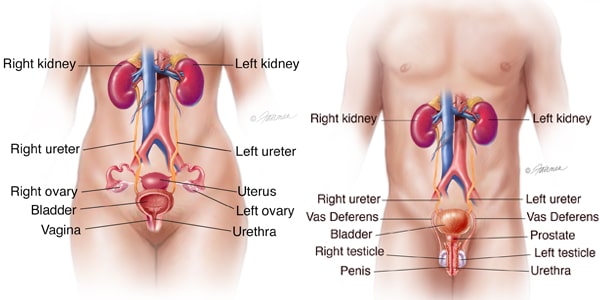
The bladder empties through the urethra and out of the body (called voiding). The female urethra is much shorter than the males. In males, urine must travel a longer distance from the bladder through the penis.
In males, the first 1" to 2" of the urethra that urine passes through is called the posterior urethra. The posterior urethra includes:
- the bladder neck (the opening of the bladder)
- the prostatic urethra (the part of the urethra by the prostate)
- the membranous urethra
- a muscle called the external urinary sphincter
Strictures that happen in the first 1" to 2" of the urethra that urine passes through are called posterior strictures.
In males, the final 9" to 10" of the urethra is called the anterior urethra. The anterior urethra includes:
- the bulbar urethra (under the scrotum and perineum- the area between the scrotum and anus)
- the penile urethra (along the bottom of the penis)
- the meatus (the exit at the tip of the penis)
Strictures that happen in the last 9" to 10" of the urethra that urine passes through are called anterior strictures.
Causes
Men are more likely to have a urethral disease or injury because of their longer urethra. For this reason, strictures are more common in men. They are rare in women and in infants.
Stricture (narrowing of the urethra) can happen at any point from the bladder to the tip of the penis. This narrowing restricts or slows the flow of urine. Some common causes are:
- trauma to the urethra
- infection such as a sexually transmitted disease
- damage from surgical tools
- conditions that cause swelling
In most cases, no cause can be found.
In adults, urethral strictures are most often due to:
- injury from a fall onto the scrotum or perineum
- prostate surgery
- kidney stone removal
- urinary catheterization
- other surgical tools
Symptoms
Simply put, the urethra is like a garden hose. When there is a kink or narrowing along with the hose, no matter how short or long, the flow is reduced. When a stricture is narrow enough to decrease urine flow, you will have symptoms. Problems with urinating, UTIs, and swelling or infections of the prostate may occur. A severe blockage that lasts a long time can damage the kidneys.
Some signs are:
- urine stream spraying
- bloody or dark urine
- blood in semen
- slow or decreased urine stream
- pain with urinating
- abdominal pain
- urethral leaking
- UTIs in men
- swelling of the penis
- loss of bladder control
Diagnosis
There are several tests to determine if you have a urethral stricture including:
- physical exam
- urethral imaging (X-rays or ultrasound)
- urethroscopy (to see the inside of the urethra)
- Urethroscopy
- Retrograde Urethrogram
Prevention
- Avoid injury to the urethra and pelvis.
- Be careful with self-catheterization
- Use lubricating jelly liberally
- Use the smallest possible catheter needed for the shortest time
- Avoid sexually transmitted infections.
- Gonorrhea was once the most common cause of strictures.
- Antibiotics have helped to prevent this.
- Chlamydia is now the more common cause.
- Infection can be prevented with condom use, or by avoiding sex with infected partners.
- If a problem occurs, take the right antibiotics early. Urethral strictures are not contagious, but sexually transmitted infections are.
Treatment
There are many options depending on the size of the blockage and how much scar tissue is involved.
Treatments include:
- Dilation – enlarging the stricture with a gradual stretching
- Urethrotomy – cutting the stricture with a laser or knife through a scope
- Open surgery – surgical removal of the stricture with reconnection and reconstruction, possibly with grafts (urethroplasty)

